
A Simple Guide to Identifying Seashells
Why Shells Arrive in Such Mixed Company
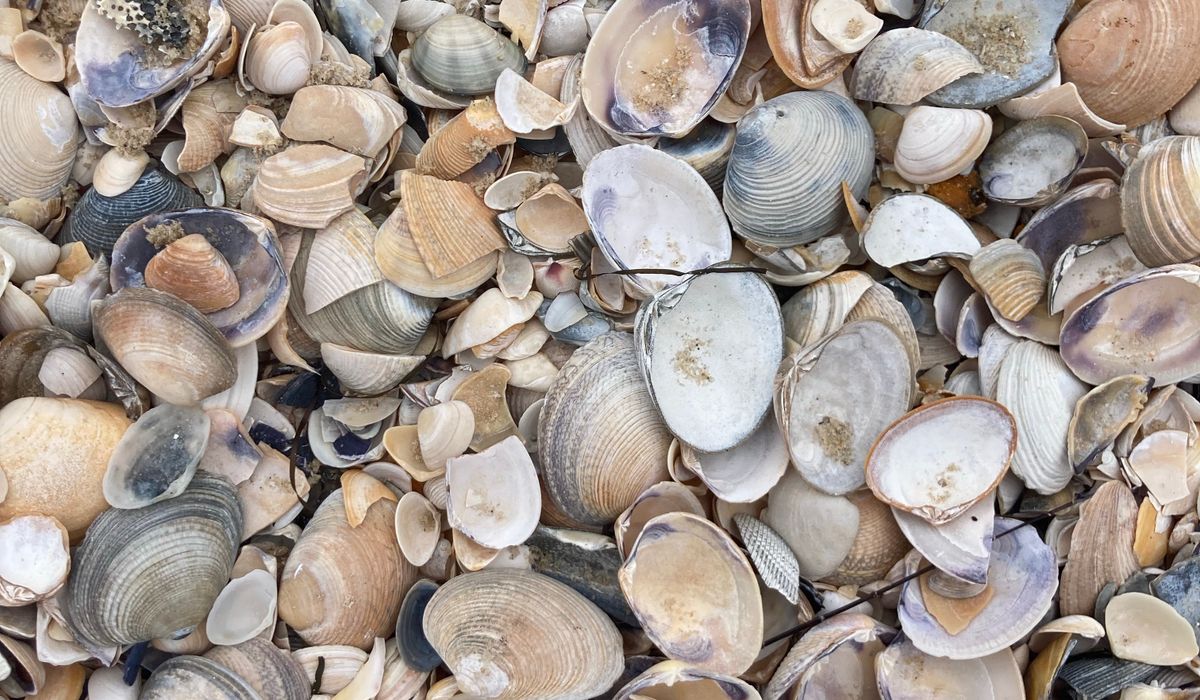
Walk any UK strandline after a decent onshore blow and you will find a jumble: cockles beside whelks, scallops tucked under razor shells, fragments of oyster worn smooth as pebbles. The sea does not sort its rubbish; it deposits whatever tide and current have carried, so a single metre of beach can hold a dozen species. The trick to identifying them is method rather than memory. Almost every shell was made by either a bivalve, with two matching halves and a hinge, or a gastropod, a single spiralled or conical shell. Get that first division right and the rest follows.
Start With the Hinge: Identifying Bivalves
Bivalves — cockles, mussels, scallops, oysters, clams and their kin — live between two valves joined by a flexible ligament at the hinge. A single valve is what you will nearly always find, and it has a definite geometry. Look for the umbo: a small raised bump, often the oldest part of the shell, sitting off-centre near the hinge line. Facing the umbo, the shell has a front and a back, a left and a right. Once you have found it, you have a reference point for everything else.
From there, three questions separate most bivalves:
- Is it fan-shaped with ears? Scallops and queen scallops have a broad triangular shell with two flat tabs, or ears, either side of the umbo. Radiating ribs run from the umbo to the outer edge.
- Is it heart-shaped with strong ribs? The common cockle has 22 to 28 bold ribs, a thick shell and a curved, heart-like outline when seen from the umbo. It is one of the most familiar finds on sandy beaches.
- Is it long and straight? Razor shells and pod razor shells are elongated, gaping at both ends, with a hinge that barely deserves the name. They look like the handle of a cut-throat razor, hence the common name.
Mussels are the easy exception: smooth, wedge-shaped, blue-black to brown, with fine growth lines but no ribs. Oysters are irregular, layered, and often cemented together in rough clumps.
Count the Spirals: Whelks, Winkles and Limpets
Gastropods build a single shell that coils as the animal grows. The oldest part is the apex, the tiny point at the top; the newest is the aperture, the opening where the animal's foot and head emerge. Hold the shell with the aperture facing you and the apex up, and you are looking at it in the same orientation the living animal held.
Counting whorls and noting the shape of the aperture will get you most of the way:
- Whelks are large and heavy, with a broad body whorl, a distinct siphonal canal at the base of the aperture, and spiral ridges along the length of the shell.
- Winkles are small and conical, with a rounded aperture and fine spiral lines. Flat winkles are squat; rough winkles are ridged. They cluster on rocky shores.
- Limpets are conical with no visible coil — just a smooth, grey-green cone with a faint apex and an oval base. They are gastropods, but their spiral is compressed almost flat.
- Topshells are conical with a pearly interior and a spiral pattern of spots or chevrons on the outside.
Read the Ribs and Ridges
Sculpture — the ribs, ridges, striations and spines on a shell — is often more useful than colour, which fades quickly in the surf. Two patterns cover most finds. Radial ribs run from the umbo or apex outwards, like the spokes of a wheel. Concentric lines run parallel to the growing edge, like tree rings. Many shells have both, forming a cross-hatched or cancellate texture.
On a cockle, the ribs are radial and strong, with the shell smooth or faintly grooved between them. On a scallop, the ribs are radial and often scaly or spiny. On a tellin or a clam, the sculpture is usually concentric and fine, giving a polished, banded look. On a whelk, the ridges spiral along the whorl rather than radiating from a single point.
Telling Apart the Common Confusions
Some finds trip up even regular beachcombers. A few quick checks:
- Cockle or clam? Cockles have bold radial ribs and a heart-shaped outline from the umbo; most clams are smoother, flatter and more oval.
- Slipper limpet or limpet? Slipper limpets are gastropods with a small internal shelf or "slipper" inside the aperture, and they often stack in chains. True limpets have no shelf and a simple conical shell.
- Scallop or oyster? Scallops are symmetrical with ears and radiating ribs; oysters are irregular and layered, and lack ears entirely.
- Whelk or winkle? Size aside, whelks have a siphonal canal — a notch or short channel at the base of the aperture — while winkles do not.
A Few Habits for Happier Beachcombing
Take a small notebook, or photograph shells in the hand with something for scale. Collect only a few and leave the rest: shells are homes for hermit crabs, nesting material for birds, and part of the beach's own structure. Avoid taking live shells — if the animal is still inside, put it back below the tide line. Check local byelaws on protected sites, and never collect from nature reserves without permission. Finally, wash your hands after handling, and keep an eye on the tide. The best finds often appear on the falling tide just after a storm, along the strandline where the last high water has laid out its hoard.


A community beach clean needs a safe site, gloves, bags and a plan for rubbish. Keep groups small and record what you collect.
Coastal weather can shift quickly. Check wind direction, swell forecasts and visibility before committing to an exposed shoreline walk.
Autumn brings fungi to dune grassland and mossy slacks. Some form partnerships with plants, while others break down buried organic matter.
Golden hour draws crowds to the coast. Respect nesting birds, private land and other visitors while chasing the perfect seaside sunset.